Best River Cruises in Europe: Top Lines and Routes 2026
The best river cruises in Europe combine small-ship intimacy with deep cultural access. No other cruise style puts you this close to cathedral squares, vineyard slopes, and medieval city walls.
According to the Cruise Lines International Association, European river cruising consistently ranks among the fastest-growing cruise segments globally. Passenger numbers on European rivers have increased sharply year over year since 2022.
This article covers the top cruise lines, scenic routes, cabin types, solo supplement realities, and seasonal timing. It tells you what the brochures skip and which rivers genuinely reward the investment.
Best River Cruises in Europe: What You Need to Know First
The best river cruises in Europe are small-ship sailings on the Danube, Rhine, Douro, and Seine rivers. Ships typically carry between 100 and 200 passengers, docking directly in city centers without tendering.
This direct docking is the defining advantage of European river cruising. You walk off the ship and into the heart of Bruges, Budapest, or Bordeaux within minutes of waking up.
First-time cruisers should note that river cruise ships are dramatically smaller than ocean ships. There are no rock-climbing walls, Broadway productions, or casino floors. The focus is entirely on the destination.
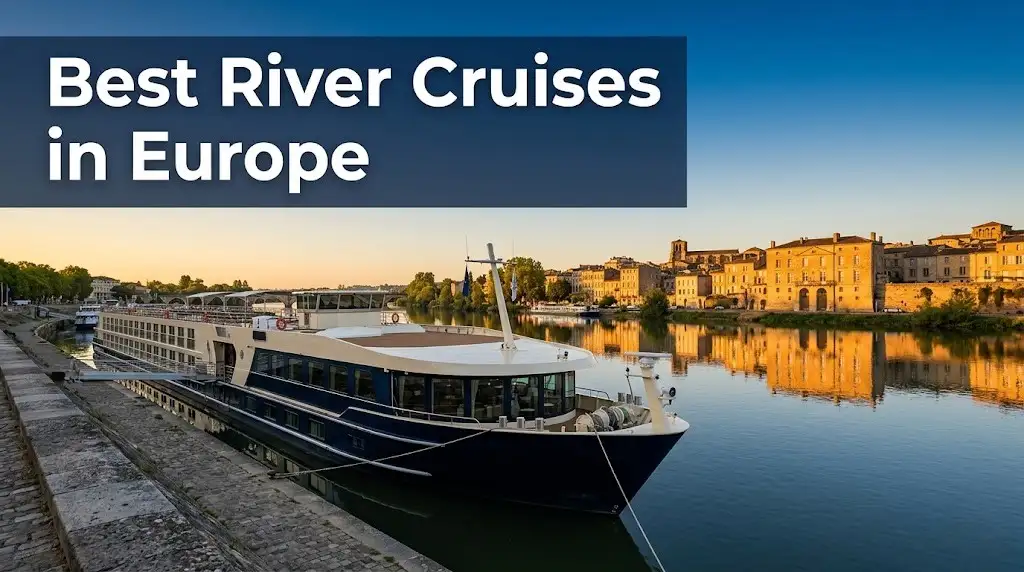
Cruise lines operating in this space include Viking River Cruises, AmaWaterways, Avalon Waterways, Scenic Cruises, Emerald Cruises, Tauck River Cruises, and Uniworld Boutique River Cruise Collection.
Every line uses a similar ship size and format. The differences come down to all-inclusive level, cabin design, excursion quality, and price tier.
Insider Tip:
- Book the cruise that best matches your river and itinerary preference first, then compare lines on price and inclusions.
- River cruise ship quality is more consistent across lines than ocean cruise quality. The river and route matter as much as the line.
- Budget travelers should know that most European river cruises fall in the premium-to-luxury price tier. Fares generally start above $2,000 per person before flights.
Most Scenic River Cruises in Europe
The most scenic river cruises in Europe sail the Rhine, Douro, and Moselle rivers. These three routes offer the most dramatic landscapes, including steep vineyard terraces, castle ruins, and gorge passages.
The Rhine Gorge between Koblenz and Bingen is widely cited as one of Europe’s most photogenic river stretches. Passengers on Rhine itineraries typically pass through this section in the afternoon for optimal lighting.
The Douro River in Portugal offers something entirely different. Terraced vineyards drop straight to the water, and the river winds through remote cork oak forests that feel genuinely isolated from mass tourism.
The Moselle River, shared between Germany and Luxembourg, offers even fewer passengers per sailing than the Rhine. Moselle itineraries from cruise lines like AmaWaterways and Avalon Waterways tend to attract experienced river cruisers seeking less-traveled routes.
Scenic Cruises operates its Scenic Space-Ships on Rhine and Danube routes with an enclosed “sun deck lounge” that allows panoramic viewing in all weather conditions. This is a genuine design advantage over open-air-only decks.
Experienced cruisers often rate the Douro as the standout for scenery. The Rhine is the more convenient choice for first-timers, given easy access from Amsterdam and more flight options.
| River | Top Scenery | Cruise Lines | Scenic Highlight |
|---|---|---|---|
| Rhine | Rhine Gorge castles | Viking, AMA, Avalon | Castle-lined gorge, Cologne Cathedral |
| Douro | Terraced vineyards | AmaWaterways, Scenic, Emerald | Remote wine country, schist villages |
| Moselle | Rolling wine hills | AmaWaterways, Avalon | Smaller crowds, Bernkastel-Kues |
| Danube | Budapest skyline | All major lines | Wachau Valley, Bratislava Old Town |
| Seine | Normandy cliffs | Viking, Scenic, Emerald | Giverny, Les Andelys castle |
Best River Cruise Lines in Europe Compared
The best river cruise line in Europe depends on your all-inclusive expectations, cabin preferences, and price tolerance. No single line is the correct answer for every traveler.
Viking River Cruises is the largest player in European river cruising. Its fleet of Longship-class vessels carries approximately 190 passengers per ship on Danube, Rhine, and other European routes.
AmaWaterways operates ships including the AmaCerto and AmaStella on Rhine, Danube, Douro, and Moselle routes. AmaWaterways ships typically carry 156 to 196 passengers and are known for a full-restaurant dining experience rather than a single dining room.
Avalon Waterways distinguishes itself with its Suite Ships, which feature floor-to-ceiling sliding-glass windows that open the entire cabin wall to the river. Avalon carries approximately 128 to 166 passengers per vessel.
Tauck River Cruises operates a smaller, highly curated fleet including vessels like the ms Inspire. Tauck’s all-inclusive model is among the most genuinely comprehensive, covering almost all gratuities and most excursions. Verify current inclusions directly before booking.
Uniworld Boutique River Cruise Collection positions itself at the luxury end of the market with boutique-hotel-style ship interiors. Its ship S.S. Maria Theresa on the Danube is one of the most visually distinctive vessels in river cruising.
Luxury travelers should compare Tauck, Uniworld, and Scenic first. These three lines compete most directly at the top tier. Viking and Avalon serve the premium mid-tier more accurately.
| Cruise Line | Ship Class Example | Passengers | All-Inclusive Level | Best Route | Price Tier | Honest Limitation |
|---|---|---|---|---|---|---|
| Viking River Cruises | Viking Longship | ~190 | Partial (wine/beer with meals, 1 excursion/port) | Danube, Rhine | Premium | Solo supplement applies; excursion quality varies by port |
| AmaWaterways | AmaCerto, AmaStella | 156-196 | Partial plus extras | Rhine, Danube, Douro | Premium-Luxury | Cabins on lower decks are smaller |
| Avalon Waterways | Suite Ships (Impression) | 128-166 | Partial | Danube, Rhine | Premium | Less brand recognition for independent port access |
| Scenic Cruises | Scenic Gem, Scenic Jasper | ~169 | Near all-inclusive | Rhine, Danube | Luxury | Premium price; not ideal for first-timers on a budget |
| Emerald Cruises | Emerald Dawn, Emerald Star | ~182 | Partial | Rhine, Danube, Douro | Mid-Premium | Fewer included excursions than Scenic or Tauck |
| Tauck River Cruises | ms Inspire, ms Joy | ~98-130 | Most inclusive | Danube, Rhine | Luxury | Small fleet limits itinerary frequency |
| Uniworld | S.S. Maria Theresa | ~120-150 | Near all-inclusive | Danube, Rhine | Ultra-Luxury | Highest nightly rate in the segment |
Verify all inclusions and pricing directly with each cruise line before booking, as policies and fares change.
Key Takeaway: Match your cruise line to your all-inclusive expectations first, your route second, and your price tier third.
Best Danube River Cruise
The best Danube river cruise connects Amsterdam or Nuremberg to Budapest in 7 to 15 nights, passing through Vienna, Passau, and Bratislava. The Danube is the most popular river in European river cruising and the most competitive in pricing.
Viking River Cruises dominates Danube itineraries by fleet size. Its Longships run Danube routes nearly year-round, with Christmas markets departures in November and December typically selling out 12 to 18 months in advance.
Budapest is the Danube’s most celebrated destination. The Hungarian Parliament Building, seen from the river at night, is one of the genuinely great visual moments in European travel. Most Danube itineraries include at least one evening in Budapest.
Vienna is the other anchor port. Most cruise lines include a full day with a guided city tour and free time in the afternoon. The Wachau Valley between Melk and Krems is typically a sailing highlight rather than a port stop.
AmaWaterways offers a popular 7-night Danube itinerary pairing Vilshofen with Budapest, with stops in Passau, Linz, and Vienna. Verify the current itinerary structure directly with AmaWaterways before booking.
Families with children should know that Danube itineraries have very limited kids’ programming. Most river cruise lines do not offer dedicated children’s clubs. River cruising suits adults and teenagers with genuine cultural interest, not younger children expecting onboard activities.
Insider Tip:
- Book Danube Christmas markets sailings at least 12 months in advance. These are among the fastest-selling sailings in all of river cruising.
- The Wachau Valley stretch is typically navigated during daylight. Ask your cruise line which direction your sailing runs so you know whether to expect the valley in morning or afternoon light.
- Danube sailings departing from Budapest run westward, which reverses the itinerary order. Both directions are equally scenic.
Best Rhine River Cruise
The best Rhine river cruise sails from Amsterdam to Basel, Switzerland, in 7 to 8 nights, passing through Cologne, Koblenz, Bingen, and Strasbourg. The Rhine is the most geographically convenient European river cruise for US travelers.
Amsterdam’s direct flight connections from multiple US hubs make Rhine embarkation straightforward. Avalon Waterways and Viking River Cruises both offer frequent Rhine departures from Amsterdam throughout spring, summer, and autumn.
Cologne Cathedral, visible from the ship as you pass through the city, is one of the most recognizable Gothic structures in Europe. Most Rhine itineraries include a half-day or full-day stop in Cologne.
Strasbourg is the Rhine’s most distinctive port. The city is culturally French but geographically German, with a medieval quarter called the Grande Ile that earned UNESCO World Heritage status. Most Rhine cruise lines include a guided walking tour of Strasbourg.
Emerald Cruises operates its Emerald Star-Ship class vessels on Rhine routes. Emerald positions itself slightly below Scenic in price tier, making it a practical option for travelers wanting higher inclusions than Viking without reaching Scenic’s pricing.
Budget travelers should note that the Rhine is the most competitive river in pricing due to high ship frequency. Shoulder season departures in April and October typically offer better rates than peak June and July sailings. Verify current pricing directly with each cruise line before booking.
According to Cruise Critic’s river cruise editorial ratings, Rhine itineraries consistently rank among the highest in passenger satisfaction scores for port variety and cultural depth.
Douro River Cruise Portugal
The Douro River in Portugal offers the most intimate and least crowded river cruise experience in Europe. Most Douro sailings operate on ships carrying 72 to 106 passengers, significantly smaller than Rhine or Danube vessels.
AmaWaterways and Scenic Cruises both operate dedicated Douro ships. The AmaDouro and Scenic Jasper are purpose-built for the river’s narrower locks and shallower passages.
Porto is the Douro embarkation city for most itineraries. Most sailings run 7 to 8 nights from Porto inland to the Spanish border town of Barca d’Alva, then return downstream. The terraced Port wine vineyards of the Douro Valley are the defining visual experience.
Avalon Waterways also offers Douro itineraries on its Alegria ship. Douro sailings typically include visits to Régua, Pinhão, and Salamanca in Spain as either a port call or included shore excursion.
Douro itineraries sell out faster than Rhine or Danube departures because fewer ships operate on the river. Book at least 9 to 12 months in advance for spring and autumn dates.
Solo travelers should note that the Douro’s smaller ship sizes mean fewer solo passengers per sailing. Some travelers find this leads to a more socially connected experience. Others find it harder to find companionship if solo traveler numbers are low. Verify the solo supplement policy directly with your chosen cruise line before booking.
Insider Tip:
- Douro ships must navigate a series of locks, which passengers often watch from the sun deck. This is one of the more engaging onboard activities in river cruising.
- Pinhão is widely considered the scenic heart of the Douro Valley. Ask your cruise line whether a stop there is included or optional.
- Porto deserves at least two days before or after the cruise. The Ribeira waterfront, Livraria Lello bookshop, and port wine cellars in Vila Nova de Gaia are worth the time.
Key Takeaway: The Douro offers Europe’s most intimate river cruise with the fewest passengers per sailing, but it requires earlier booking than the Danube or Rhine.
Seine River Cruise France
Seine river cruises sail from Paris through Normandy, stopping at Rouen, Les Andelys, and Honfleur before returning. The Seine is the newest of Europe’s major river cruise routes and still the least served by available ships.
Viking River Cruises and Emerald Cruises both operate Seine itineraries. Viking’s Longship class vessels and Emerald’s Star-Ships are both adapted for the Seine’s specific lock dimensions.
Paris is the primary embarkation port. Most Seine itineraries begin or end at Paris’s port near the Eiffel Tower. The Normandy D-Day beaches near Caen and Bayeux are included on most itineraries as either an excursion or independent visit.
Giverny, home of Claude Monet’s garden and the inspiration for his Water Lilies series, is a standard included stop on most Seine itineraries. Visit timing matters: spring blooms peak in May, which aligns well with the best sailing season.
The Scenic Cruises offering on the Seine, including the Scenic Diamond, covers the route with its near-all-inclusive model. This pricing structure benefits travelers who drink regularly and take most included excursions. It adds less value for passengers who prefer independent port exploration.
Experienced cruisers who have completed Danube or Rhine sailings often choose the Seine as their next European river. The itinerary is less port-dense than the Rhine but culturally distinct. Normandy’s WWII history is the content that separates the Seine from any other river cruise in Europe.
Best European River Cruise Ports
The best European river cruise ports combine walkable old towns, cultural landmarks, and sufficient time ashore for genuine exploration. Not every port is created equal in depth or time allocation.
Budapest is the most impressive single city on any European river cruise itinerary. Most Danube cruise lines allocate a full day or overnight stay. This is one of the few ports where staying onboard to save time is genuinely wasteful.
Amsterdam is the Rhine’s embarkation city and one of Europe’s most walkable capitals. Passengers typically board in Amsterdam after a pre-cruise hotel stay. Build in at least two nights to explore the Rijksmuseum, canal belt, and Anne Frank House before embarkation.
Strasbourg and Cologne are the Rhine’s strongest mid-route ports. Strasbourg’s Grande Ile district requires at least three to four hours to experience properly. Cologne’s Cathedral and Chocolate Museum can fill a half-day without rushing.
Porto on the Douro is one of Europe’s genuinely rewarding port cities. The Ribeira waterfront and the port wine caves across the river in Vila Nova de Gaia are the essential stops. Most Douro cruises give passengers ample time here.
Rouen on the Seine is the most historically significant port many travelers have never visited. Its Gothic cathedral inspired a famous Monet series. Joan of Arc’s trial and execution took place in Rouen’s old marketplace, which is still marked and explained in detail.
First-time cruisers often underestimate how much walking a river cruise involves. Budapest alone requires 5 to 8 miles of walking for a full sightseeing day. Comfortable walking shoes are not optional on a river cruise.
| Port | River | Time Needed | Must-See | Honest Note |
|---|---|---|---|---|
| Budapest | Danube | Full day or overnight | Parliament, Buda Castle, ruin bars | Uphill walk to Castle District |
| Amsterdam | Rhine | 2 pre-cruise nights | Rijksmuseum, canal belt | Embarkation city; bikes everywhere |
| Strasbourg | Rhine | 3-4 hours minimum | Grande Ile, European Parliament | Short stop on many itineraries |
| Cologne | Rhine | Half day | Cathedral, Chocolate Museum | Very tourist-heavy in summer |
| Porto | Douro | 2-3 hours or more | Ribeira, Livraria Lello, wine caves | Pre-cruise nights recommended |
| Rouen | Seine | 3 hours | Gothic Cathedral, Joan of Arc site | Often undervisited; worth full afternoon |
| Bratislava | Danube | 2-3 hours | Old Town castle, SNP Bridge | Smaller but walkable and genuine |
What Is Included in a European River Cruise
What is included in a European river cruise varies significantly by cruise line and fare class. No single definition of “all-inclusive” applies across the entire category.
Viking River Cruises includes wine and beer with dinner, one shore excursion per port, and Wi-Fi in its standard fare. Specialty wines, cocktails outside meal service, and premium excursions cost extra. Verify the current inclusion list directly with Viking before booking.
AmaWaterways includes a wider beverage package across most sailing hours, not just at meals. Gratuities are typically included, which removes a significant variable cost. Current AmaWaterways inclusions should be verified directly before booking, as they may differ by itinerary and fare promotion.
Tauck River Cruises includes most gratuities, almost all shore excursions, and a comprehensive beverage program in its standard fare. Tauck’s all-inclusive model is genuinely among the most complete in the category. Still, verify current inclusions before booking, as specific excursion coverage can change.
Scenic Cruises markets itself as “all-inclusive” and typically covers beverages throughout the day, shore excursions, and gratuities. Scenic’s electric bikes available in port add genuine independent exploration value. Confirm current inclusion levels directly with Scenic before booking.
Budget travelers should map total cost carefully. A lower base fare from Emerald Cruises or Viking may reach the same total spend as Tauck or Scenic once gratuities and excursions are added. Calculate the full-cost comparison, not the headline fare.
According to Condé Nast Traveler’s cruise coverage, the gap between lines in all-inclusive value is one of the most consistent points of confusion among first-time river cruise passengers.
Key Takeaway: Always calculate total cost including gratuities and excursions, not just the headline fare, when comparing European river cruise lines.
River Cruise Cabin Types in Europe
European river cruise ships offer three to four main cabin categories: standard staterooms, French balcony staterooms, panoramic suites, and on some ships, dedicated solo cabins. Ship dimensions on European rivers limit cabin size across all categories.
A French balcony is not a walk-out balcony. It is a floor-to-ceiling sliding glass door that opens to a railing with no exterior standing space. Some travelers find this disappointing. Others prefer the open-air feel without the wind.
Avalon Waterways Suite Ships offer the widest panoramic window opening in the category. The floor-to-ceiling sliding wall creates an open-air feel that genuinely distinguishes Avalon’s cabin experience from Viking’s more standard window design.
Viking Longship cabins on the Veranda deck feature a small step-out balcony with two chairs. These are true walk-out balconies, which are rare on European river ships and worth specifying when booking.
AmaWaterways offers a twin-balcony cabin design on many of its ships. These cabins include both a French balcony on one side and a small outside balcony on the upper deck side, accessed by climbing a few steps. Verify current cabin configurations on your specific ship before booking.
Solo travelers should ask specifically about solo cabin availability at booking. Most European river cruise lines do not have dedicated solo cabins, unlike ocean cruise ships such as Norwegian Breakaway. Solo passengers typically occupy a standard cabin and pay a supplement.
| Cabin Type | Description | Best For | Honest Note |
|---|---|---|---|
| Standard Inside | No window or small porthole | Budget focus | Rare on river ships; most have natural light |
| Standard Stateroom | Fixed window | Value seekers | Most common entry-level cabin |
| French Balcony | Floor-to-ceiling sliding door, no exterior space | River views without full balcony | Not a walk-out; disappoints some travelers |
| Step-Out Balcony | Small exterior deck with chairs | True outdoor time | Available on Viking Veranda deck and AMA select ships |
| Panoramic Suite | Larger cabin, premium views, extra amenities | Luxury travelers | Significant price increase; verify inclusions |
| Solo Cabin | Single occupancy; rare on river ships | Solo travelers | Most lines charge a solo supplement on standard cabins instead |
Best Time for European River Cruises
The best time for European river cruises is April through May and September through October. These months combine comfortable temperatures, manageable crowds, and stable water levels on the Danube and Rhine.
Spring sailings (April and May) benefit from blooming tulip fields along the Rhine near Amsterdam and fresh greenery throughout the Douro Valley. Temperatures across most river itineraries stay in the 55 to 70 degrees Fahrenheit range. Verify conditions specific to your route when booking.
Autumn sailings (September and October) offer harvest season in wine country, including the Rhine’s grape harvest and the Douro’s Vindima season. Foliage on the riverbanks turns amber and gold by late October, which many passengers consider the river’s most photogenic season.
Summer sailings (June through August) are the busiest and most expensive. Ports are significantly more crowded in July and August. The Danube faces its highest low-water risk in late July and August.
Christmas markets sailings on the Rhine and Danube run from mid-November through late December. These are the most sought-after river cruise departures in the entire European calendar. Book 12 to 18 months in advance. Temperatures hover near freezing but the market atmosphere is genuinely distinctive.
Experienced cruisers often cite October as their personal preference. Port crowds are lighter than summer, river conditions are generally stable, and the harvest season adds specific cultural content to wine-country stops.
| Month | Conditions | Crowds | Water Risk | Price Tier | Verdict |
|---|---|---|---|---|---|
| April | Cool, blooming tulips | Low to moderate | Low | Mid | Excellent |
| May | Warm, green | Moderate | Low | Mid-High | Excellent |
| June | Warm to hot | High | Low to moderate | High | Good; book early |
| July | Hot | Very high | Moderate (Danube) | Peak | Avoid Danube |
| August | Hot | Very high | High (Danube) | Peak | Avoid Danube |
| September | Warm, harvest season | Moderate | Low | Mid-High | Excellent |
| October | Cooler, foliage | Low to moderate | Low | Mid | Excellent |
| November-December | Cold, Christmas markets | High at market ports | Low | Variable | Book early; unique experience |
European River Cruise Low Water Disruptions
Low water on European rivers is a real operational risk that no major cruise line markets clearly. When water levels drop below navigable thresholds on the Danube or Rhine, ships cannot sail or must reduce speed significantly.
The Danube faces its highest low-water risk in late July and August, particularly in the stretch between Regensburg and Passau. The Rhine faces its primary low-water risk in late summer and early autumn, particularly through the Rhine Gorge section.
When low water prevents sailing, cruise lines typically substitute bus transportation between ports and board passengers at a different point on the river. This is not the same experience as sailing the route. Some passengers feel significantly misled when this occurs.
What cruise lines generally do in low-water situations:
- Continue the itinerary by replacing river sailing segments with motorcoach transfers between ports.
- Adjust the itinerary to sail only the navigable sections and skip affected segments.
- Offer a partial credit or future booking discount depending on the severity of the disruption. Policies vary by line. Verify your specific cruise line’s low-water policy before booking.
- In extreme cases, cancel the sailing and offer rebooking. This is rare but has occurred on the Danube.
Experienced cruisers who have dealt with low-water substitutions consistently recommend booking spring or October departures to reduce this risk. The disruption is not rare. It has affected thousands of passengers in recent years.
Important Accuracy Note: Low-water disruption policies differ across cruise lines. Some include disruption protection in their standard contract. Others do not. Read the specific cancellation and disruption clause in your booking contract before paying a deposit.
Best River Cruise for Solo Travelers
The best river cruise for solo travelers combines a reduced or waived solo supplement, an onboard social environment suited to single passengers, and itineraries where independent port exploration is genuinely practical. The Danube and Rhine are the strongest matches.
AmaWaterways has offered select sailings with reduced solo supplements on specific cabin categories. These promotions are limited and booking-window dependent. Verify current solo pricing directly with AmaWaterways before assuming any offer applies to your sailing date.
Avalon Waterways has also offered solo-friendly promotions on select departures. Verify availability and specific cabin categories directly before booking.
The social environment on a river cruise ship with 100 to 190 passengers is naturally more intimate than an ocean cruise ship with 3,000 passengers. Solo travelers often find it easier to form genuine connections with other passengers during excursions, at shared dining tables, and in the panorama lounge.
Viking River Cruises does not consistently offer reduced solo supplements as a standard policy. Solo passengers on Viking typically pay a supplement based on cabin category and sailing date. Verify directly before booking.
Tauck River Cruises attracts an older and often solo demographic on some sailings. Tauck’s inclusion of most excursions means solo travelers do not pay separately for the majority of port activities, which reduces the total cost gap versus couple travelers.
Solo female travelers should note that European river cruise ports are generally among the safest in Europe for independent exploration. Budapest, Vienna, Cologne, and Porto are all walkable and safe during daylight hours. Use standard urban awareness at night in any city.
According to Solo Traveler World, river cruising ranks consistently among the top cruise styles recommended for solo travelers because of its small ship size and naturally communal dining format.
Key Takeaway: AmaWaterways and Avalon Waterways offer the most frequent solo supplement promotions; verify current availability directly before booking any European river cruise as a solo traveler.
European River Cruise Solo Supplement
The European river cruise solo supplement typically adds 25% to 100% of the per-person double-occupancy rate to the solo fare. This varies significantly by cruise line, cabin category, and specific sailing date.
Viking River Cruises charges a solo supplement on all standard cabin categories. The supplement percentage varies by sailing date and availability. There is no dedicated solo cabin equivalent to what Norwegian Breakaway offers ocean cruise solo travelers.
AmaWaterways and Avalon Waterways periodically offer specific sailings with a reduced solo supplement of 25% to 50% rather than the full 100% penalty. These offers are time-limited and inventory-dependent. Verify before booking.
Emerald Cruises has offered select solo-friendly pricing on some departures. Emerald’s lower base price tier compared to Scenic or Tauck means the supplement’s absolute dollar impact is somewhat lower, even at the same percentage. Verify current pricing directly.
Tauck River Cruises charges a solo supplement but its fully inclusive model means that excursions and gratuities are already covered. The net total cost difference between a solo Tauck passenger and a solo Viking passenger can narrow when all-in costs are added.
How to reduce the solo supplement impact:
- Book during a promotion period when AmaWaterways or Avalon is marketing reduced solo supplements.
- Ask a CLIA-certified travel agent specifically about solo deals, as some promotions are available through agents before public listing.
- Choose a shorter itinerary to limit the total supplement exposure.
- Travel during shoulder season, when base fares are lower and supplement impact is proportionally smaller.
- Compare total cost including excursions and gratuities, not just the headline solo supplement percentage.
Important: Solo supplement policies and promotional offers change frequently without notice. Always verify the exact supplement amount for your specific sailing date and cabin category directly with the cruise line before paying any deposit.
River Cruise vs. Ocean Cruise in Europe
European river cruises and Mediterranean ocean cruises are genuinely different products serving different traveler preferences. Choosing between them depends on what you value most: port immersion or onboard entertainment.
River cruises dock in city centers without tendering. You walk off the ship directly into the destination. Ocean cruises in Europe anchor offshore in some ports and use tender boats to bring passengers to shore, which adds time and logistics.
River cruise ships carry 100 to 200 passengers. European ocean cruise ships on the same itinerary routes carry anywhere from 600 passengers on a small Azamara vessel to over 5,000 on a Royal Caribbean or MSC mega-ship.
The onboard experience difference is significant. River cruise ships offer one dining room, a lounge or two, a sun deck, and no casino, no production shows, no water park, and no specialty restaurant row. Ocean ships offer all of those.
Budget travelers face a clear decision. Mediterranean ocean cruise fares on a mainstream line like Norwegian Cruise Line or Royal Caribbean start meaningfully lower per person than river cruise fares. If budget is the primary concern, an ocean cruise delivers more value per dollar spent at sea.
Premium travelers often find river cruises offer a more genuinely destination-focused experience than a balcony cabin on a large ocean ship. The proximity to every port and the absence of embarkation-day chaos are meaningful differences.
Families with children should choose ocean cruising in almost every case. River cruise lines offer essentially no kids’ programming. Ocean cruise lines including Royal Caribbean, Norwegian Cruise Line, and Carnival Cruise Line have structured youth programs for children from ages 3 and up.
| Feature | River Cruise | European Ocean Cruise |
|---|---|---|
| Passenger count | 100-200 | 600-5,000+ |
| Port access | Walk-off in city center | Sometimes by tender |
| Onboard entertainment | Minimal; destination-focused | Full: shows, pools, casinos |
| All-inclusive potential | Moderate to high | Low to moderate (varies by line) |
| Families with kids | Not suitable | Well-suited on major lines |
| Solo supplement | Common; varies by line | Common; some lines offer solo cabins |
| Price tier | Premium to luxury | Budget to ultra-luxury |
| Best for | Port immersion, couples, culture | Entertainment, families, wider budgets |
European River Cruise Best Value
The best value European river cruise balances all-inclusive inclusions, port quality, and fare against total trip cost including flights, gratuities, and excursions. The line with the lowest headline fare is rarely the best value once all costs are counted.
Emerald Cruises consistently positions itself as the most accessible price tier among established river cruise lines. Emerald’s Star-Ship vessels carry approximately 182 passengers on Rhine and Danube routes. Fewer excursions are included than on Scenic or Tauck, but the base fare is meaningfully lower.
Viking River Cruises offers strong value for the price tier when its included shore excursion per port is fully used. For travelers who prefer independent exploration, Viking’s value proposition weakens because the excursion inclusion is less relevant to their travel style.
The best value calculation for a European river cruise should include:
- Base cruise fare per person
- Applicable solo supplement if traveling alone
- Flights to and from embarkation city (Amsterdam, Budapest, Porto, or Paris)
- Gratuities if not included in the fare
- Pre- and post-cruise hotel nights (almost always recommended)
- Optional shore excursions not covered by the base fare
- Travel insurance (strongly recommended for river cruises given low-water disruption risk)
Budget travelers should target Emerald Cruises or Viking River Cruises on shoulder season departures in April or October. These two lines on these dates deliver the closest approximation to a budget-accessible European river cruise.
Travel + Leisure identifies Avalon Waterways as a strong mid-tier value option, particularly for travelers who prioritize cabin design over the widest excursion inclusion.
Insider Tip:
- Book directly with a CLIA-certified travel agent for river cruises. Agents often access group rates or promotional inclusions not available on cruise line websites.
- Repositioning sailings, where a ship moves from one river to another at the end of a season, occasionally offer sharply reduced fares. Ask your agent specifically about these.
- Travel insurance is not optional on a European river cruise. Low-water disruptions, flight delays into European gateway cities, and itinerary changes are all realistic scenarios. Verify your policy covers river cruise disruption specifically.
Important Accuracy and Safety Notes for European River Cruising
River cruise itinerary changes, low water disruptions, and solo supplement pricing are the most volatile elements of European river cruise planning.
Verify the following before booking or departure:
- Confirm your cruise line’s exact low-water disruption policy in writing before paying a deposit.
- Confirm your specific solo supplement amount for your exact cabin category and sailing date directly with the cruise line, not from a general website or third-party listing.
- Confirm all-inclusive inclusions for your specific fare class. Promotional inclusions sometimes apply only to certain booking windows.
- Confirm Schengen Area entry requirements for your nationality, particularly if combining the river cruise with additional European travel. US citizens currently do not require a Schengen visa for stays under 90 days, but entry requirements can change.
- Confirm travel insurance covers river cruise disruption, including low-water itinerary changes and motorcoach substitutions.
The single most important action before booking: calculate total cost including flights, gratuities, pre-cruise hotel, and excursions before comparing fares across cruise lines.
Frequently Asked Questions About Best River Cruises in Europe
What is the best river cruise in Europe for first-time cruisers?
The Danube river cruise between Vilshofen or Nuremberg and Budapest suits first-timers best.
It includes the highest concentration of landmark cities per sailing, including Vienna, Bratislava, and Budapest.
Viking River Cruises and AmaWaterways both offer well-structured Danube itineraries with included excursions that orient first-timers without requiring independent navigation.
Which European river cruise line is the most all-inclusive?
Tauck River Cruises and Scenic Cruises offer the most genuinely all-inclusive European river cruise fares among major lines.
Both typically include most gratuities, beverages throughout the sailing day, and almost all shore excursions in the base fare.
Verify current inclusion levels directly with each line before booking, as promotional fares and standard fares can differ significantly in what they cover.
How much does a European river cruise cost per person?
European river cruise fares typically start in the range of $2,000 to $3,500 per person for a 7-night sailing on an entry-level or mid-tier line during shoulder season.
Luxury lines like Scenic, Tauck, and Uniworld typically run $4,000 to $8,000 or more per person for a 7 to 8-night sailing before flights.
Add flights, pre-cruise hotels, travel insurance, and optional excursions to arrive at a realistic total budget; verify all current pricing directly before booking.
Do European river cruises charge a solo supplement?
Most European river cruise lines charge a solo supplement ranging from 25% to 100% of the per-person double-occupancy rate.
AmaWaterways and Avalon Waterways have offered select sailings with reduced solo supplements on specific cabin categories and booking windows.
Verify the exact supplement amount for your specific sailing date and cabin category directly with the cruise line before paying any deposit.
What is the best time of year for a river cruise in Europe?
April through May and September through October are the best months for European river cruises.
These months offer comfortable temperatures, stable water levels on the Danube and Rhine, and lower port crowds than peak summer.
Christmas markets sailings in November and December on the Rhine and Danube are a popular alternative but sell out 12 to 18 months in advance.
What happens if low water cancels my European river cruise?
If low water prevents sailing, cruise lines typically substitute motorcoach transfers between ports rather than canceling the trip outright.
Passengers are transported by coach to each port city and reboard the ship where the river becomes navigable again.
Verify your specific cruise line’s low-water policy before booking and confirm that your travel insurance policy explicitly covers river cruise disruption including itinerary changes from low-water conditions.
Choose Your River, Then Your Line
The single most important river cruise decision is choosing your river before choosing your cruise line. The Danube delivers the greatest city concentration. The Rhine delivers the strongest scenery per day. The Douro delivers the most intimate and wine-focused experience. The Seine delivers the most culturally specific content through Normandy.
Once your river is chosen, compare cruise lines on total cost rather than headline fare. Verify every inclusion directly with the cruise line or a CLIA-certified travel agent. Pricing, gratuity policies, solo supplements, and excursion inclusions all change without public notice.
Book at least 9 to 12 months in advance for peak departures. For Christmas markets sailings, book 12 to 18 months out. Travel insurance covering river cruise disruption is not optional.