Repositioning Cruises 2026: Full Guide to Deals and Routes
Repositioning cruises deliver some of the lowest per-night fares in ocean cruising. Ships move between deployment regions seasonally, and cruise lines fill those cabins at steep discounts.
According to the Cruise Lines International Association, the average cruise fare per day has risen consistently since 2022. Repositioning sailings remain a consistent exception to that trend.
This guide covers every repositioning cruise route, which cruise lines offer the best deals, how to handle one-way flight logistics, and what solo travelers need to know before booking.
Repositioning Cruises: What They Are and Why They Exist
Repositioning cruises exist because cruise ships follow the passengers, not the other way around.
Cruise lines deploy ships to specific regions based on seasonal demand. Caribbean routes peak in winter. Mediterranean routes peak in summer. Alaska sailings run May through September.
Ships cannot be in two places simultaneously. Between seasons, they physically move to the next deployment region.
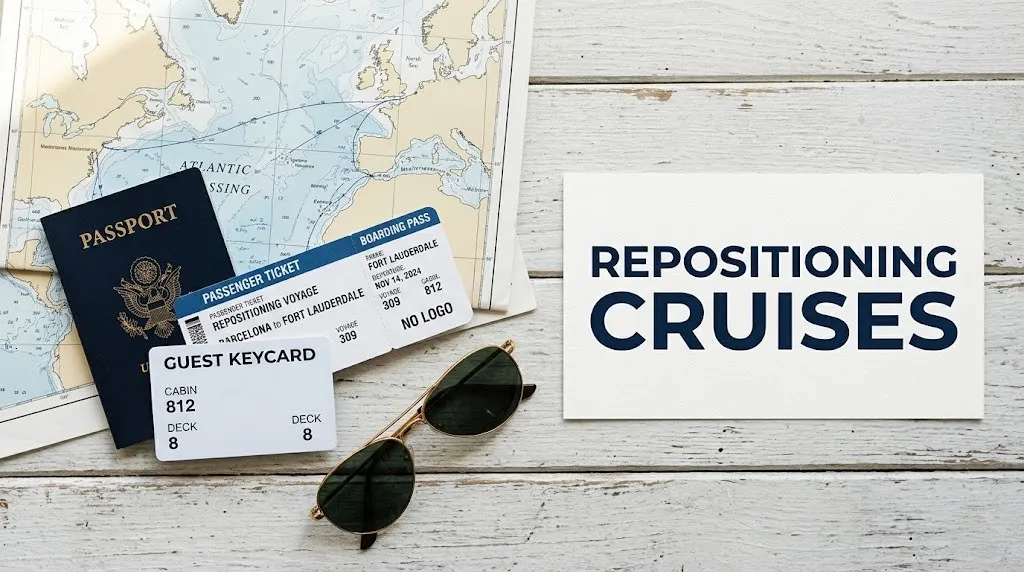
That transit is the repositioning sailing. The cruise line must move the ship regardless of how many passengers are aboard.
Filling cabins at a discount is better than sailing empty. That math is why repositioning fares consistently run below market-rate itinerary pricing.
First-time cruisers often misunderstand repositioning sailings as a special promotional product. They are simply a logistics necessity that cruise lines have turned into a passenger offering.
Insider Tip:
- Repositioning sailings are not marketed as heavily as standard Caribbean or Mediterranean itineraries.
- Search specifically by route type (transatlantic, transpacific) rather than by destination to surface these sailings.
- Cruise line websites often categorize them under “Special Sailings” or list them by departure and arrival region.
What Is a Repositioning Cruise (and How Is It Different from a Regular Cruise)
A repositioning cruise is a one-directional sailing that moves a ship from one seasonal deployment region to another.
A regular cruise returns to its departure port. A repositioning cruise does not. You disembark in a different city, country, or sometimes continent than where you boarded.
That single structural difference creates two practical consequences. You need a separate plan to get home. You also cover far more ocean miles than a standard round-trip sailing covers.
The itinerary typically includes a few port stops early or late in the sailing. The middle of the crossing is often consecutive sea days with no port calls.
Standard cruise itineraries average one or two sea days per sailing. A repositioning crossing can include five to ten consecutive sea days.
Experienced cruisers often consider this a feature. Travelers who need daily port activity typically find it frustrating.
| Feature | Repositioning Cruise | Standard Round-Trip Cruise |
|---|---|---|
| Return to departure port | No | Yes |
| Sea day concentration | High (5 to 10 days) | Low (1 to 3 days) |
| Per-night fare | Lower | Higher |
| Itinerary flexibility | Limited: one direction | Full: multiple options |
| Flight requirement | Two flights or open-jaw | One round-trip |
| Best for | Flexible, sea-day-comfortable travelers | Any profile |
Relocation Cruises vs. Transatlantic Crossings: Key Differences
Relocation cruises and transatlantic crossings both move ships across ocean regions, but they are not the same product.
A transatlantic crossing is a specific route between North America and Europe, typically crossing the Atlantic Ocean. A relocation cruise is any one-directional seasonal ship transfer, regardless of which ocean it crosses.
Cunard’s Queen Mary 2 has operated scheduled transatlantic crossings between New York and Southampton since 2004. That is a year-round product specifically designed as a crossing experience.
Repositioning sailings on Holland America Line, Celebrity Cruises, or Norwegian Cruise Line are seasonal transfers. They happen twice a year per ship when deployment regions change.
The Queen Mary 2 crossing is engineered for ocean travel. The ship’s hull and stabilizer system handle North Atlantic conditions better than ships designed primarily for Caribbean deployment.
Budget travelers comparing the two should note that Queen Mary 2 fares typically run higher than seasonal repositioning fares on mainstream lines, but the product is fundamentally different.
According to Cruise Critic’s editorial team, the Queen Mary 2 is the only purpose-built ocean liner still in regular service. Other transatlantic repositioning sailings use resort ships making a seasonal transit.
Reposition Cruises Seasonal Timing: When They Happen and Why
Repositioning cruises happen primarily in April through May and October through November.
Spring sailings move ships from the Caribbean to Europe or Alaska as Mediterranean and Alaska seasons open. Fall sailings reverse the movement as northern deployments close.
Spring repositioning: Caribbean or Florida to Europe (April to May), Alaska preparation sailings (April), Hawaii to Alaska (April to May).
Fall repositioning: Europe to Caribbean (October to November), Alaska to Caribbean or Mexico (September to October), transpacific sailings (October to November).
The two repositioning windows are not equal in conditions or demand. Spring sailings often feature calmer Atlantic conditions and better shoulder-season pricing in European ports.
Fall transatlantic sailings are more common but carry tail-end hurricane-season risk through September. October sailings are generally safer for North Atlantic crossings.
Important Accuracy Note: Fall Transatlantic Repositioning Timing
Hurricane season in the Atlantic runs from June through November. Peak risk months are August and September. October repositioning sailings can still encounter late-season tropical weather events.
Verify the following before booking:
- Check the National Hurricane Center’s seasonal outlook for the departure year.
- Confirm your cruise line’s storm policy and itinerary change procedure.
- Verify whether your cruise line includes weather-related itinerary deviation insurance or whether you need independent travel insurance.
How to Find Repositioning Cruises in 2026
Finding repositioning cruises requires searching differently than you would search for a standard sailing.
Cruise line websites do not always clearly label repositioning sailings. Search by departure port and arrival port rather than destination to surface them.
To find repositioning cruise deals in 2026:
- Go to the cruise line’s website directly. Navigate to “Cruise Finder” or “Search Cruises.” Filter by departure port and set the destination to a different region or continent.
- Use Cruise Critic’s search tool, which allows filtering by cruise type including repositioning and transatlantic sailings.
- Check Vacations To Go, which specifically lists repositioning cruises under a dedicated category.
- Contact a CLIA-certified travel agent. Agents with cruise specialization often receive repositioning fare alerts before deals appear publicly.
- Set up email fare alerts directly through the cruise line or a booking platform. Repositioning deals can appear and sell out within days.
- Search by itinerary length rather than destination. Sailings over 14 nights departing in April, May, October, or November are most likely repositioning transfers.
Budget travelers get the best repositioning fares by booking 6 to 9 months in advance for first cabin selection. Last-minute repositioning deals do appear 60 to 90 days before departure but with limited cabin choice.
According to Cruise Lines International Association, traveler demand for longer cruise itineraries has grown consistently since 2023. Repositioning fares still represent significant per-night savings versus standard Caribbean or Mediterranean sailings of similar length.
Best Cruise Lines for Repositioning Cruises
The best cruise line for a repositioning sailing depends on what you prioritize: sea-day programming, solo-friendly cabins, included amenities, or price.
Holland America Line is the most consistently praised line for sea-day programming. Ships like the HAL Rotterdam and HAL Nieuw Amsterdam offer extensive onboard enrichment during sea days, including culinary demonstrations, lectures, and music programming.
Celebrity Cruises operates repositioning sailings on Celebrity Edge, Celebrity Apex, and Celebrity Beyond. The Edge class ships have strong dining and entertainment for extended sea-day stretches.
Norwegian Cruise Line offers studio cabins on ships including the Norwegian Breakaway and Norwegian Bliss, making it one of the most solo-friendly mainstream options for repositioning routes.
Princess Cruises Grand-class ships reposition between Caribbean and Alaska deployments. Princess’s MedallionClass technology keeps sea-day activities organized and accessible.
Cunard Line’s Queen Mary 2 offers the only purpose-engineered transatlantic crossing product. It suits premium and luxury travelers who want a true ocean liner experience rather than a seasonal transfer sailing.
| Cruise Line | Featured Ship | Passengers | Price Tier | Repositioning Specialty | Honest Limitation |
|---|---|---|---|---|---|
| Holland America Line | HAL Rotterdam | 2,666 | Mid-premium | Sea-day programming, Europe routes | Older demographic; limited nightlife |
| Celebrity Cruises | Celebrity Apex | 2,910 | Premium | Edge class onboard quality | Higher fares than mainstream lines |
| Norwegian Cruise Line | Norwegian Breakaway | 3,998 | Mid-range | Solo studio cabins | Large ship; can feel impersonal at sea |
| Princess Cruises | Grand Princess | 2,600 | Mid-range | Alaska/Caribbean repositioning | MedallionClass app has a learning curve |
| Cunard Line | Queen Mary 2 | 2,691 | Premium | Transatlantic purpose-built crossing | Formal dress code may not suit all travelers |
| MSC Cruises | MSC Magnifica | 2,550 | Budget-mid | Europe to Caribbean fall routes | Limited English-language programming at times |
Verify solo supplement policies, included amenities, and 2026 specific cabin availability directly with each cruise line before booking.
Repositioning Cruises from Boston
Boston’s Black Falcon Cruise Terminal serves as a repositioning embarkation point primarily in spring and fall.
Boston departures tend to be fall repositioning sailings heading south toward the Caribbean as New England cruise season closes in October and November.
Holland America Line and Princess Cruises have historically offered Boston departures for fall Caribbean repositioning sailings. Specific 2026 sailing dates should be verified directly with each cruise line.
Boston embarkation is a practical advantage for travelers from New England, upstate New York, and eastern Canada. Driving avoids the cost of flying to Fort Lauderdale or Miami.
The Black Falcon Terminal sits in the Seaport District, roughly 3 miles from Logan International Airport. Uber and rideshare services from Logan to the terminal typically take under 15 minutes.
Parking at the Black Falcon Terminal is available but fills quickly for popular sailings. Book parking in advance through the Massachusetts Port Authority website.
First-time cruisers departing from Boston should note that embarkation lines for Boston sailings are generally shorter and less chaotic than those at Fort Lauderdale or Miami’s larger terminals.
Experienced cruisers planning a repositioning sailing from Boston should confirm whether the itinerary includes a stop in Bermuda, Halifax, or directly heads to the Caribbean. Itineraries vary by year and ship.
Insider Tip:
- Boston repositioning sailings often depart in October and November when New England fall foliage has peaked.
- Combining a New England road trip with a Boston repositioning departure is a natural extension for travelers driving from the mid-Atlantic.
- Verify 2026 specific Boston departure dates early; Boston is a smaller homeport than Miami and sailings sell out faster.
Repositioning Cruises from New York and Fort Lauderdale
New York’s Manhattan Cruise Terminal and Fort Lauderdale’s Port Everglades are the two highest-volume US embarkation points for repositioning sailings.
New York offers spring transatlantic repositioning sailings in April and May. Ships depart for Southampton, Rotterdam, Barcelona, and Lisbon before beginning Mediterranean deployments.
Norwegian Cruise Line’s Norwegian Breakaway has operated spring transatlantic repositioning sailings from New York. Cunard’s Queen Mary 2 departs New York for Southampton on a schedule that includes seasonal repositioning transfers.
Fort Lauderdale’s Port Everglades serves as the primary fall repositioning arrival and spring departure port. More transatlantic repositioning sailings depart from or return to Fort Lauderdale than any other US port.
Celebrity Cruises and Holland America Line both use Port Everglades heavily for transatlantic and Caribbean repositioning movements.
Fort Lauderdale’s proximity to Miami gives travelers two major international airports. Fort Lauderdale-Hollywood International Airport is directly adjacent to Port Everglades, making pre-cruise arrival logistics straightforward.
Budget travelers flying into Fort Lauderdale the night before embarkation should book hotels in the Port Everglades area rather than in Miami. Miami hotels run significantly higher. Verify specific 2026 hotel availability and pricing independently before booking.
Key Takeaway: Repositioning cruises from New York and Fort Lauderdale represent the widest selection of transatlantic sailings for US travelers; spring and fall are the primary booking windows.
Transatlantic Repositioning Cruises: Routes, Ports, and What to Expect
A transatlantic repositioning cruise crosses the Atlantic Ocean between North America and Europe, typically in 9 to 14 nights.
The most common routes run between Florida or New York and Southampton, Rotterdam, Barcelona, or Lisbon.
Typical port stops on a spring transatlantic repositioning route include:
- Nassau, Bahamas: Often the first port after Florida departure. Verify whether your sailing includes Nassau.
- Bermuda: Some spring transatlantic sailings stop in Hamilton, Bermuda before crossing.
- Ponta Delgada, Azores: A mid-Atlantic stop common on longer repositioning crossings. The Azores offer whale watching and volcanic landscape hiking within easy walking distance of the port.
- Funchal, Madeira: A port stop on many southerly transatlantic routings. Madeira’s cable car and botanical gardens are accessible on a half-day independently.
- Lisbon, Portugal: A common final stop or disembarkation point before continuing to Southampton or Rotterdam.
Crossing the North Atlantic means sea conditions differ significantly from Caribbean or Mediterranean cruising. Swells of 6 to 10 feet are common on open Atlantic crossings, particularly in November.
Travelers with motion sensitivity should select ships with larger passenger capacities and higher stabilizer ratings. The Queen Mary 2, HAL Rotterdam, and Celebrity Apex handle ocean swell better than smaller ships designed for coastal routes.
According to Condé Nast Traveler’s 2024 cruise coverage, the Azores stop on transatlantic repositioning sailings is one of the most underappreciated port experiences in ocean cruising. Independent exploration from the Ponta Delgada pier is straightforward.
Transpacific Repositioning Cruises: Routes, Conditions, and Best Lines
A transpacific repositioning cruise crosses the Pacific Ocean, typically between Hawaii or the US West Coast and Japan, Australia, or New Zealand.
These sailings run significantly longer than transatlantic repositioning crossings, typically 14 to 21 nights.
Princess Cruises and Holland America Line operate the most consistent transpacific repositioning sailings for US travelers. Celebrity Cruises occasionally includes transpacific repositioning routes in its seasonal schedule.
Common transpacific repositioning routes include:
- Los Angeles or San Francisco to Tokyo or Yokohama (spring, April to May)
- Honolulu or Ensenada to Sydney or Auckland (fall, October to November)
- Vancouver to Tokyo (repositioning from Alaska season to Asia deployment)
The North Pacific in November presents rougher conditions than the spring transpacific routes. Spring sailings from Los Angeles to Tokyo cross calmer North Pacific waters.
Experienced cruisers who have done transatlantic repositioning sailings should note that transpacific crossings include more consecutive sea days. A Los Angeles to Yokohama sailing can include 8 to 11 consecutive days at sea.
Important Accuracy Note: Transpacific Timing and Typhoon Season
Typhoon season in the western Pacific runs June through November. Fall transpacific repositioning sailings entering the western Pacific in October and November should account for this risk.
Verify the following before booking:
- Confirm with the cruise line whether the itinerary includes ports in typhoon-risk zones during peak season months.
- Purchase independent travel insurance that covers weather-related itinerary changes and missed port calls.
- Review the U.S. State Department’s travel advisory for Japan, South Korea, or your Pacific destination port before departure.
Key Takeaway: Transpacific repositioning cruises offer the highest sea-day counts in ocean cruising; book only if extended consecutive days at sea genuinely appeal to you.
Repositioning Cruise Deals and Booking Windows
The best repositioning cruise deals appear 6 to 9 months before departure for interior and ocean view cabins.
Balcony and suite repositioning fares often hold closer to standard seasonal pricing. The deepest discounts concentrate on inside cabins and ocean view categories.
To get the best repositioning cruise deal:
- Set a fare alert on the cruise line website or through Cruise Critic’s fare tracking tool.
- Compare interior cabin pricing across at least three cruise lines for the same route window.
- Check whether port fees and taxes are included in the advertised fare. They often are not in the initial quoted price.
- Calculate the total cost by adding gratuities, a drink package if applicable, and one-way or open-jaw flight costs before comparing to a standard cruise fare.
- Ask your CLIA-certified travel agent about group space or early-booking incentives, which sometimes apply to repositioning sailings.
Last-minute repositioning deals do appear, but cabin selection is limited and inside cabin inventory often sells out first.
Budget travelers should note that repositioning cruise “deals” sometimes carry higher add-on costs than comparable standard sailings. A $700 repositioning fare with $300 in gratuities, a $400 drink package, and a $500 one-way flight can exceed the cost of a standard 7-night Caribbean cruise at full fare.
Verify all-in pricing directly with the cruise line or through a CLIA-certified travel agent before treating the base fare as the full cost of the sailing.
Transition Cruises and Open-Jaw Booking Logistics
A transition cruise is a repositioning sailing that requires you to start in one city and end in another city in a completely different region.
That one-way structure creates the single most commonly overlooked planning challenge: the open-jaw flight.
An open-jaw flight means flying into one city and out of another. Flying into Fort Lauderdale for a spring transatlantic and flying home from Barcelona after disembarkation requires two separate one-way flights or an open-jaw booking through a single airline.
Open-jaw flights frequently cost more than a standard round-trip to the same destination. Budget that cost into the full repositioning cruise calculation before booking.
Practical steps for transition cruise flight logistics:
- Book the repositioning cruise first to confirm exact embarkation and disembarkation ports.
- Search open-jaw flight pricing on Google Flights or a travel booking platform using separate city inputs for departure and return.
- Compare open-jaw pricing to two one-way flights separately. Sometimes two one-ways are cheaper than an open-jaw booking.
- Book return flights as soon as cruise disembarkation port and date are confirmed. Transatlantic return flights from Europe in May and October sell out well in advance.
- Build in at least one extra night before embarkation if flying to the departure port from a different city. Cruise lines do not wait for delayed passengers.
First-time cruisers frequently miss the return flight entirely during the excitement of booking a discounted repositioning fare. Budget the return travel cost before the cruise purchase feels financially settled.
According to Solo Traveler World, solo travelers on repositioning cruises should also plan post-cruise accommodation in the disembarkation city if they intend to explore before flying home.
Sea Days on Repositioning Cruises: What to Actually Expect
A repositioning cruise typically includes 5 to 10 consecutive sea days, which is the defining experience of this type of sailing.
Sea days on a repositioning cruise are not like sea days on a Caribbean cruise. There is no port the following morning to reset the pace. The ship is the destination for multiple days running.
Holland America Line designs its ships specifically for sea-day travelers. The HAL Rotterdam and HAL Nieuw Amsterdam offer library programming, culinary arts center classes, and dedicated lecture series during extended crossings.
Celebrity Cruises Edge-class ships run enrichment programs, cooking demonstrations, and poolside entertainment during sea days. The Celebrity Apex has a larger variety of dining venues that make multi-day sea stretches feel less repetitive.
Norwegian Cruise Line’s larger ships like the Norwegian Bliss have extensive entertainment: multiple Broadway-style shows, a racetrack, and a laser tag facility. These features specifically help time-heavy sea day schedules.
Budget travelers should not assume sea day programming is free. Specialty classes, wine tastings, cooking school sessions, and spa services on sea days cost extra on most mainstream cruise lines. Verify which sea-day activities are included in the fare before booking.
Travelers prone to boredom on sea days should read Cruise Critic forum threads specifically about sea days on transatlantic repositioning sailings. Honest passenger reviews describe the reality of 8 consecutive days at sea better than any cruise line’s brochure.
Key Takeaway: Sea-day quality varies dramatically by cruise line; Holland America Line’s enrichment programming and Celebrity’s Edge-class amenities lead the mainstream field for extended repositioning crossings.
Repositioning Cruise Packing List
A repositioning cruise requires different packing than a standard 7-night Caribbean sailing.
You are covering more climates, more ocean days, and more formal and informal onboard settings than a short Caribbean round-trip requires.
Key packing differences for repositioning sailings:
- Sea-day clothing: You need more casual, comfortable onboard clothing for multiple consecutive days without port stops. Resort wear designed for daily disembarkation is insufficient.
- Motion sickness preparation: Open-ocean crossings on the North Atlantic and North Pacific are rougher than enclosed Caribbean or Mediterranean sailing. Pack prescription or over-the-counter motion sickness medication and verify access to the ship’s medical center.
- Layers for open-ocean conditions: Deck temperatures during an Atlantic or Pacific crossing drop significantly compared to Caribbean deployment. A wind-resistant layer and a warm mid-layer are practical necessities.
- Formal night attire: Most cruise lines schedule multiple formal nights on longer sailings. Cunard’s Queen Mary 2 has specific black-tie expectations on formal nights. Verify your cruise line’s dress code before packing.
- Power adapters if disembarking in Europe or Asia: European ports use different electrical standards. Pack adapters if you plan to continue traveling after disembarkation.
- Return luggage logistics: Repositioning sailings end in a different city than they started. Consider whether you can manage your luggage independently through a European or Asian city before flying home.
Solo travelers packing for a repositioning cruise should also consider packing fewer formal items and more flexible versatile clothing. Extended sea days favor comfort over occasion-specific attire.
Solo Repositioning Cruises and Solo Supplements
Solo travelers can book repositioning cruises, but the solo supplement is the most important financial factor to evaluate before committing.
Most mainstream cruise lines charge a solo supplement of 50% to 100% of the double-occupancy cabin rate when a single traveler occupies a cabin. On a 14-night repositioning sailing, that supplement can rival or exceed the discounted base fare.
Norwegian Cruise Line is the strongest mainstream option for solo repositioning travelers. The Norwegian Breakaway and Norwegian Bliss include studio cabins priced for single occupancy without the standard double-occupancy penalty. Studio cabins on these ships include access to the Studio Lounge, a private social space for solo guests.
Cunard’s Queen Mary 2 has historically offered single-occupancy cabins in the Britannia Club category for transatlantic sailings. Availability is limited. Verify directly with Cunard before booking.
Celebrity Cruises and Holland America Line typically charge a standard solo supplement on most cabin categories. Some promotional fares reduce or waive the supplement seasonally. Verify any promotional solo pricing directly with the cruise line before committing.
Solo female travelers on repositioning sailings should research the onboard social atmosphere specific to their chosen cruise line. According to Solo Traveler World, Holland America Line’s demographic skews older, which some solo female travelers find more socially comfortable during extended sea-day crossings than the party-oriented atmosphere on larger Norwegian ships.
Meeting other passengers during extended sea days is significantly easier on repositioning cruises than on short Caribbean sailings. The extended time onboard naturally creates social interaction at the ship’s bar, library, enrichment lectures, and pool deck. Solo travelers consistently report making more connections on repositioning sailings than on standard round-trip cruises of shorter length.
Verify solo supplement policies for each specific 2026 sailing directly with the cruise line. Promotional solo pricing is not guaranteed across all repositioning sailings.
Are Repositioning Cruises Worth It
Repositioning cruises are worth the discounted fare if you have schedule flexibility, genuinely enjoy sea days, and account for all the real costs before booking.
They are not worth it if you measure value purely by the base fare without calculating the open-jaw flight, solo supplement, gratuities, drink packages, and any pre-cruise hotel costs.
The honest calculation looks like this: a 14-night transatlantic repositioning inside cabin fare may run $800 to $1,400 per person depending on the line, season, and booking window. Add estimated gratuities (verify with your cruise line), a drink package if you use one, Wi-Fi if needed, and a one-way return flight from Europe. The total frequently reaches $2,500 to $4,000 per person before any specialty dining or shore excursions.
That total is still competitive against booking 14 nights in European hotels plus flights. But it is not the $60-per-night bargain the base fare headline suggests.
Luxury and premium travelers should compare repositioning fares on Celebrity Cruises Edge-class ships to standard Mediterranean sailings on the same ships. The repositioning fare often includes comparable onboard quality at a lower per-night rate but with significantly more sea days and fewer port experiences.
Families with young children should approach repositioning cruises with caution. Kids programming on extended sea-day sailings varies significantly by cruise line and ship. Verify whether your target ship’s kids club operates during sea days on repositioning itineraries specifically, not just during standard Caribbean deployments.
Repositioning cruises deliver genuine value for the right traveler. That traveler is flexible, sea-day-comfortable, unbothered by one-directional travel logistics, and honest with themselves about the total cost before booking.
Frequently Asked Questions About Repositioning Cruises
What is a repositioning cruise and how does it work?
A repositioning cruise is a one-directional sailing that moves a cruise ship from one seasonal deployment region to another.
Ships cannot return to their departure port because they are physically relocating between ocean regions.
Cruise lines discount these sailings to fill cabins on a transit they must complete regardless of passenger count.
How do I find repositioning cruise deals for 2026?
Search directly on cruise line websites using departure port and a different destination region rather than searching by destination name.
Cruise Critic’s cruise search tool and Vacations To Go both allow filtering specifically for repositioning and transatlantic sailings.
Setting fare alerts through the cruise line or a CLIA-certified travel agent gives early access to repositioning deals before they appear publicly.
Are repositioning cruises good for solo travelers?
Repositioning cruises can be excellent for solo travelers, but the solo supplement significantly affects the total cost on most cruise lines.
Norwegian Cruise Line’s studio cabins on ships like the Norwegian Breakaway are priced for single occupancy and eliminate the standard supplement penalty.
Verify solo supplement policies directly with your cruise line for the specific 2026 sailing before booking.
How many sea days are there on a typical repositioning cruise?
A typical transatlantic repositioning cruise includes 5 to 8 consecutive sea days during the open-ocean crossing portion.
Transpacific repositioning sailings can include 8 to 11 consecutive sea days depending on the route length and port stop schedule.
The sea day count is the single most important factor to evaluate honestly before booking a repositioning sailing.
What is the difference between a repositioning cruise and a transatlantic crossing?
All transatlantic crossings cross the Atlantic Ocean, but not all repositioning cruises are transatlantic sailings.
Repositioning cruises include transpacific routes, Alaska-to-Caribbean transfers, and any other one-directional seasonal ship transit.
Cunard’s Queen Mary 2 is the only purpose-built ocean liner operating regular transatlantic crossings; all other transatlantic repositioning sailings use standard resort ships making a seasonal transit.
Do I need a visa for a repositioning cruise to Europe?
US citizens currently do not require a visa for most Western European ports on a repositioning cruise, but this changes in 2026 with the EU’s ETIAS authorization system.
The ETIAS travel authorization is expected to apply to US passport holders entering Schengen Area countries starting in 2025 or 2026. Verify the current ETIAS status directly with the U.S. State Department and your cruise line before booking.
Some cruise itineraries include ports outside the Schengen Area where different entry rules apply; verify each port’s requirements individually with your cruise line before departure.
Booking Your Repositioning Cruise: The Next Step
Repositioning cruises offer genuine per-night value for the traveler who understands the full cost. Calculate the open-jaw flight, solo supplement if applicable, and gratuities before the discounted base fare looks like the final number.
The clearest next step is to search for your preferred route window (April to May or October to November) directly on Holland America Line, Celebrity Cruises, Norwegian Cruise Line, or Princess Cruises. Contact a CLIA-certified travel agent to compare solo supplement policies across 2026 sailings in a single conversation.
Cruise pricing, cabin inclusions, solo supplement policies, and port itineraries change without notice. Verify every detail directly with your cruise line or travel agent before booking any 2026 repositioning sailing.